
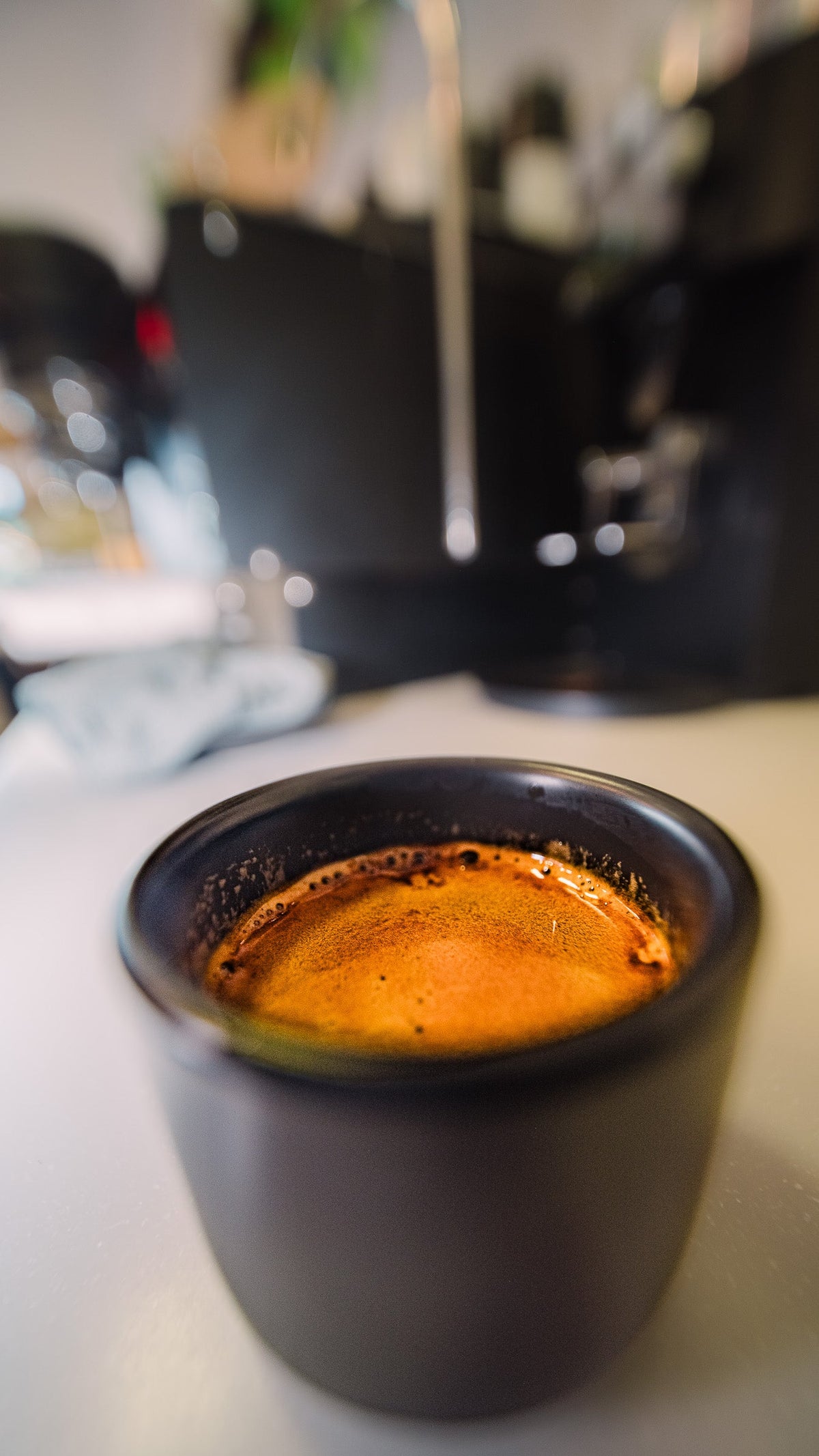
Espresso used to have a tight definition: about 18 grams in, about 36 grams out, 25 to 30 seconds, 9 bar. In 2026 that box is breaking open. Shots are running faster, ratios are running longer, and some of the most talked-about cups on the bar look more like a small filter coffee than a classic ristretto.
Turbo shots, soup shots, 1:3, 1:4, 15-second pulls. Some people call it lazy espresso. We think it is the most interesting thing to happen to the shot in twenty years, and it lines up with where we have been heading at Kinship for a while.
Where the 1:2 rule came from
The classic shot was built around dark Italian blends and the 9 bar pump machines of the mid-1900s. A fine grind, a full basket and a short yield gave a heavy, syrupy cup with thick crema that could stand up to milk. Specialty coffee kept that frame and just measured it more carefully: dose and yield on a scale, a 1:2 ratio, a 25 to 30 second target.
That recipe works. It is also a starting point that hardened into a rule. If a shot ran 18 seconds, the answer was always the same: grind finer. Nobody asked whether the coffee in the hopper actually wanted that.
The coffee changed faster than the rule. Lighter roasts, washed East African lots, high-grown Central Americans and co-ferments are denser and harder to extract. Pushed through the old recipe, they often come out sour and thin on one side of the puck and harsh on the other. That is uneven extraction, and it is where this whole shift starts.
What we have done at Kinship
We have pulled espresso at six bar since the day we opened. Looking back through our old espresso photos, the machines, baskets, recipes and even the name above the door have changed. Six bars has stayed.
We opened as Third Wave Coffee in 2016 with a three-group Slayer. It was a nightmare to maintain and liked to catch fire. But we ran six bar from day one, with 30 second pre-infusions on Slayer's needle valves, mostly through VST baskets. The shots were bright and vibrant, and close to 60 seconds long. We played with the paddle constantly, including ending shots at low pressure.
That was our starting point: long pre-infusions, lower pressure, and a willingness to keep adjusting the recipe.

In 2020 we moved to a Synesso S200 and switched to WAFO baskets, after working with VST and IMS. By then we were already pulling turbo-style shots: 21 seconds with 7 seconds of pre-infusion. Our Nova blend, a light roast we ran from 2018 to 2026, went as long as 1:4. With our house blend, WAFO has let us reach higher extractions than any earlier setup.
Today we still run six bar. Paradigm and our light single origins get under 15 seconds of pre-infusion, a 1:2.5 to 1:3.5 ratio, and finish in under 30 seconds including pre-infusion. Our house recipe sits at 1:2.78 with a quick main extraction after pre-infusion, landing around 23% extraction. It is tasting vibrant, punchy and expressive.
Those two numbers describe different things. A 1:2.78 ratio means 2.78 grams of espresso for every gram of dry coffee. A 23% extraction yield means about 23% of the coffee's dry mass dissolved into the cup. TDS describes how concentrated that cup is. The extraction number helps us understand and repeat a result; on its own, it does not tell us whether we will enjoy the shot. We drink coffee, not graphs and percentages on a chart somewhere.
We are also pulling shots under 20 seconds, and for the right single origin a full soup shot in 16 seconds is on the table.

The idea behind it is simple and we will keep saying it: we do not believe in over-extraction. When a shot tastes bitter and dry, it is almost always uneven extraction. Part of the puck ran fast and pulled too much, part of it barely got wet. Push extraction evenly and higher numbers taste better, not worse. Water always follows the path of least resistance, my baristas got tired of hearing my harp on this.

Turbo shots: the science said grind coarser
In 2020 Michael Cameron and colleagues, including Christopher Hendon and Jamie Foster, published Systematically Improving Espresso: Insights from Mathematical Modeling and Experiment. Their finding cut against everything baristas were taught. Past a certain point, grinding finer lowers extraction, because the puck clogs and water channels through the weak spots. Some of their experiments produced repeatable shots in under fifteen seconds, and Lance Hedrick's July 2021 turbo shot explainer brought the approach to a much wider audience. You hit a point of diminishing return by grinding finer and finer.
Cameron described the curve as a volcano: extraction climbs as you grind finer, peaks, then falls off. Most bars were living on the wrong side of that peak.
The fix that came out of it is now called the turbo shot:
|
|
Classic shot |
Turbo shot |
|---|---|---|
|
Dose |
18 g |
18 g |
|
Grind |
very fine |
a few steps coarser |
|
Pressure |
9 bar |
about 6 bar |
|
Time |
25–30 s |
10–18 s |
|
Yield |
about 36 g |
about 45-55 g |
|
Ratio |
about 1:2 |
about 1:2.5 to 1:3 |
The cup is lighter in body with thinner crema, but sweeter, cleaner and more repeatable. The tradeoff is mouth feel: if you love a dense, chewy shot, a turbo can feel like it is missing something.
Soup shots and the long-ratio turn
If turbo shots loosened the rules, soup takes the exploration and cranks it up a notch. The approach uses a coarser grind, a gentle initial soak, and high flow with very little pressure, generally below one bar. Lance Hedrick's August 2025 video introduced it to a much wider audience and credited the community behind it. Long ratios have spread alongside it: some cafes now serve 18 grams in and 72 grams out, a 1:4 single-origin cup.
The name is half a joke. The texture is thin and tea-like, somewhere between espresso and a pour-over. What you get back is clarity: bright, aromatic, sweet, and very forgiving because there is almost nothing to channel.
That is the counter-cultural part. These methods came out of forums, home setups and YouTube, not the competition stage. For decades the bar set the standard and home baristas copied it. Now the home community is running the experiments, and cafes are following.
The distinction matters, though. Our six-bar recipe is not a soup shot, and a quick extraction alone does not define one. These are different methods with different ways of getting water through coffee.
What it means in the cup, and how to try it
Longer and faster shots trade body for clarity. Expect less crema, a lighter texture, more sweetness and more of the origin. They shine with washed light roasts or less funky fermented coffees like Ethiopia Ardi or a honey process lot like Las Torres. They are less suited to darker roasts and chocolate-forward blends, where a fast shot can turn harsh and flat, so keep those closer to a classic recipe.
To try a turbo at home:
- Go one or two steps coarser than your usual espresso setting.
- Dose about 18 grams and aim for about 45 grams out.
- If you can set pressure, try about 6 bar.
- Expect 10 to 18 seconds. Ignore the old 30 second target.
- Sour and hollow: go slightly finer or run longer. Dry and harsh: go coarser or stop sooner.
Your grinder matters more here than anywhere. A coarse setting needs an even grind, and a grinder that throws a lot of fines and boulders will fight you.
At the shop, ask for a shot of whatever single origin is on, we are happy to nerd out with you on our espresso brew parameters.

Where we land
There is plenty of room in this picture for traditional espresso. A darker roast pulled at a shorter ratio has depth, concentrated flavor and heavy texture that people love, and we appreciate those qualities, I am a bit nostalgic for it. Lighter coffees at longer ratios give us other qualities to explore. Both deserve their flowers.
Our house shot stays at six bar and 1:2.78. Around it, expect us to keep experimenting with longer, lighter shots for the right coffees. Come by the shop in Forest and taste them side by side.
Ten years after opening, we are still interested in what happens when we change the recipe. We have enjoyed espresso that took almost a minute, and we are finding plenty to enjoy in shots that finish much sooner.
Sources
- Turbo Shot Espresso: A Detailed Exploration, CoffeeGeek
- Turbo Shot: New Expression of Espresso, or Just Laziness?, Kristian Kielmayer
- What Are Soup Shots? Low-Pressure Espresso Explained, Clive Coffee
- Espresso Trends 2026 and Beyond, Clive Coffee
Further reading:
- Cameron et al., "Systematically Improving Espresso: Insights from Mathematical Modeling and Experiment," 2020
- Lance Hedrick, "What Is and How to Dial In a Turbo Shot," July 2021
- Espresso Aficionados, "A Souper's Guide to the Oxo Rapid Brewer"
- Lance Hedrick, "Espresso Without Pressure? The SOUP Method Changing Coffee Forever," August 2025

Leave a comment
This site is protected by hCaptcha and the hCaptcha Privacy Policy and Terms of Service apply.